

Case of Pune City.
In complex urban environments, infrastructure is more than a system of physical networks—it is a living, evolving ecosystem of human experience, social negotiations, and spatial transformation. Historic cities like Pune embody this complexity, where infrastructure, culture, and contemporary dynamics continuously interact. This research challenges the traditional, technocratic view of infrastructure, typically treated as disconnected systems like transportation, utilities, and buildings, evaluated purely through metrics of efficiency and productivity. Such fragmented approaches fail to acknowledge the intricate, socially embedded realities that make urban life meaningful.


Urban theorists like Henri Lefebvre and others have long criticized the reduction of urban spaces to physical forms, emphasizing the social production of space and the performative nature of infrastructure. A road, a market, or a shrine is not just a technical or economic entity but a site where histories, class dynamics, gender relations, and everyday practices are constantly negotiated and reshaped. Infrastructure, therefore, must be seen not only as material objects but as spaces of collective memory, social practice, and cultural expression.
The research proposes rethinking infrastructure beyond its materiality. It introduces a holistic approach that integrates physical networks, social practices, historical continuities, and intangible cultural values. Public transportation, markets, streets, and parks are portrayed as stages for social life and arenas of informal activity, embodying more than their technical functions. This perspective demands a shift from traditional impact assessments like EIAs, SIAs, and CBAs, which often miss how infrastructure transforms social realities, especially in historically rich contexts.
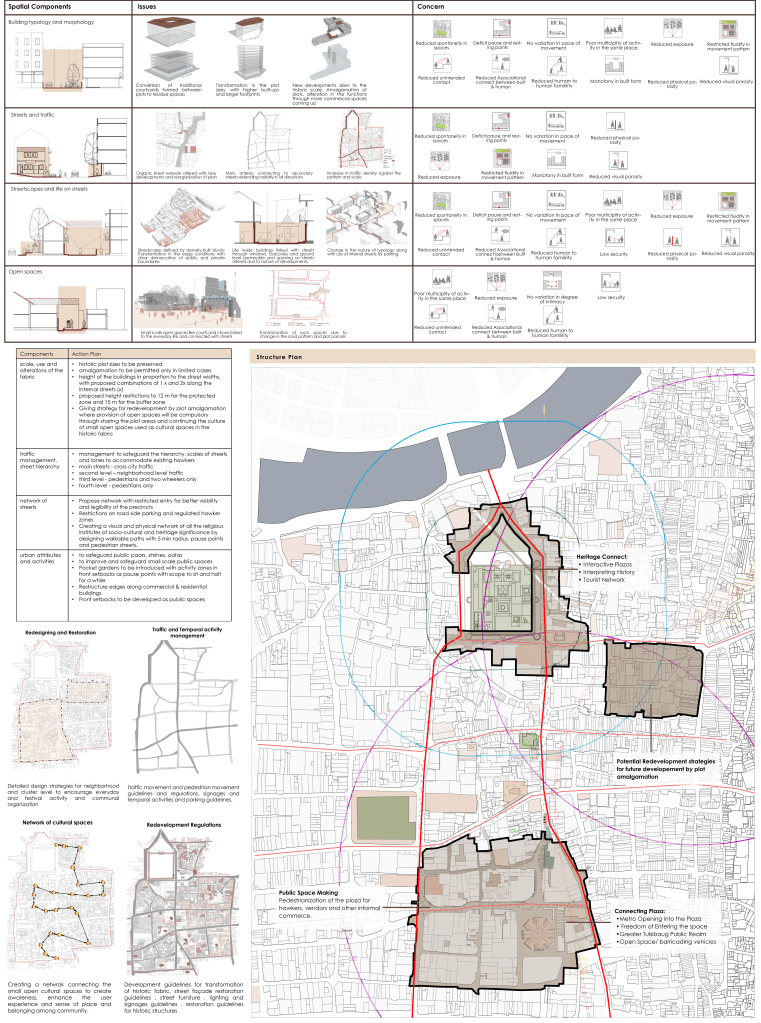
Central to this reconceptualization is the understanding of the social realm—a network of historical narratives, everyday practices, tangible artefacts like shrines and street furniture, and intangible aspects like rituals and shared memories. Each part of the social realm is deeply interconnected, where even small practices like street vending represent complex spatial negotiations and historical continuities.
The idea of “Infrastructure as Monument” is explored, not in terms of static grand structures, but in the sense of scale, public life, and socio-cultural experience. Small, local infrastructural elements, often overlooked, are crucial to understanding how urban spaces function and evolve. Moreover, infrastructure is framed as an ecosystem—a dynamic, interdependent network that adapts to the needs of its users and their cultural contexts. Streets, for example, are not just conduits for vehicles but marketplaces, public stages, and cultural venues, constantly reshaping in response to everyday rhythms and practices.
The significance of this research lies in bridging the gap between technical efficiency and social relevance. Especially in historic cities undergoing rapid transformation, this approach can help protect cultural heritage and sustain vibrant social fabrics while accommodating contemporary needs. The central research questions are: How do infrastructural systems reshape urban experiences in historic contexts? How do heritage and contemporary needs negotiate spatially? How do communities adapt and transform these spaces?

The objectives include developing a framework that moves beyond traditional understandings, critically analyzing existing assessment models, and exploring infrastructure’s role in shaping and being shaped by social life at multiple scales—from individual experiences to citywide systems. This aims to foster urban ecosystems that are equitable, resilient, and deeply connected to their cultural and social contexts.
Text & Image Credit: Kashish Shah | KRVIA Alumni | M. Arch – Urban Design Thesis | 2025


Leave a comment