
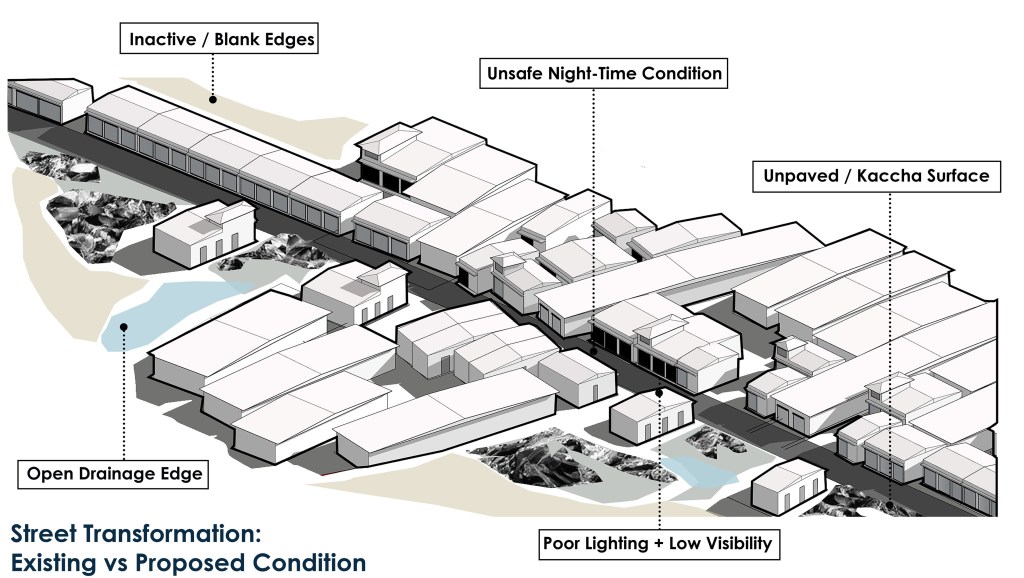
An Urban Design Approach to Gender-Inclusive Access
Cities are often evaluated by the strength of their transport systems, yet everyday
mobility is determined by much more than the availability of trains, buses, or roads. In rapidly growing peripheral neighborhoods, public transport may exist,
but reaching it safely and comfortably remains a daily challenge. These areas,
often described as transport-deficit neighborhoods, are characterized by
fragmented street networks, inadequate pedestrian infrastructure, poor
drainage, limited lighting, discontinuous public spaces, and weak last-mile
connectivity. The result is a disconnect between transport availability and actual
accessibility, where short distances become difficult journeys.
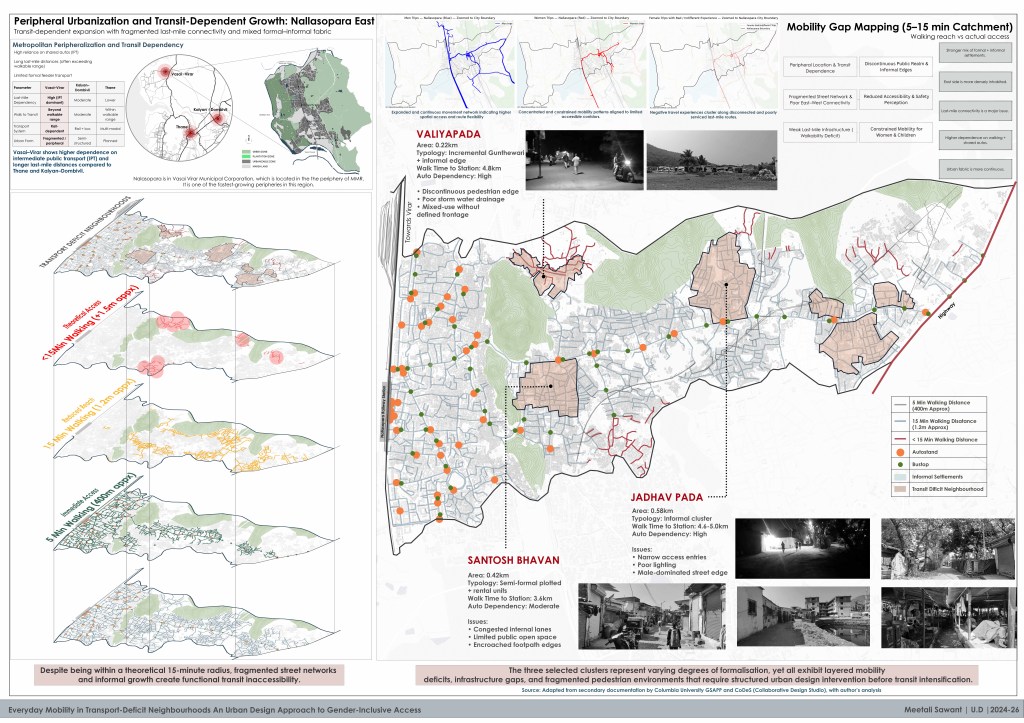
This condition is increasingly visible across the peripheral areas of the Mumbai
Metropolitan Region, where rapid urbanisation has expanded faster than
supporting infrastructure. While suburban rail networks efficiently connect the city
at a regional scale, the everyday experience of moving between home, public
transport, workplaces, schools, markets, and community spaces often depends
on informal streets, shared auto-rickshaws, and unsafe walking environments.
Here, mobility is no longer just about reaching a destination it becomes an
everyday negotiation with the built environment.
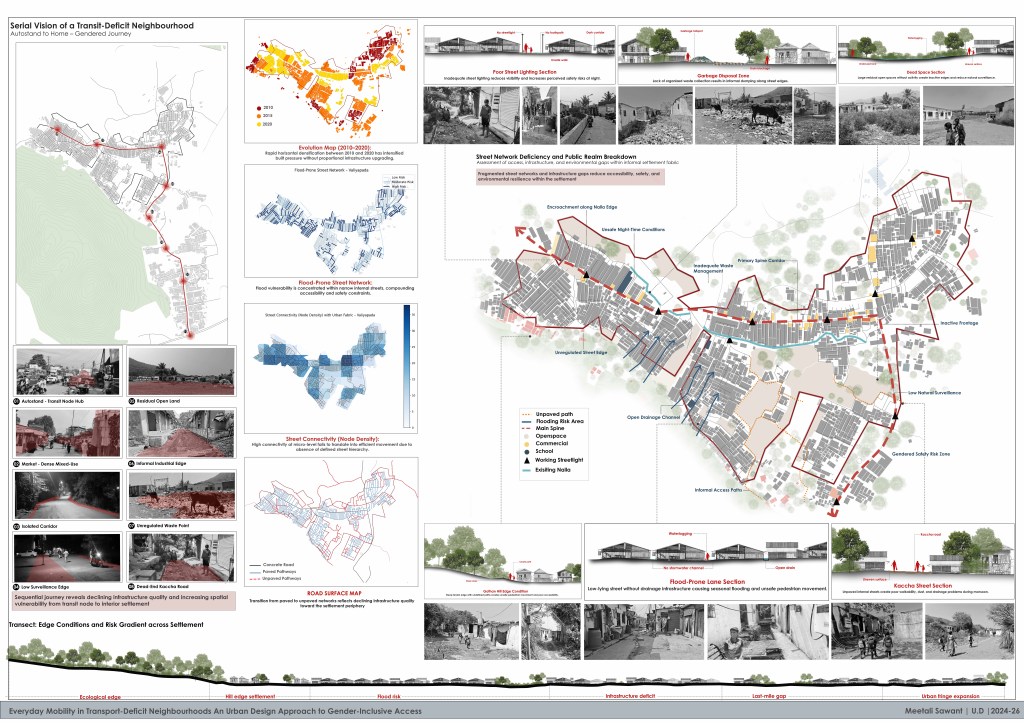
These challenges are experienced differently by women. Unlike men, whose
journeys are often direct and destination-oriented, women’s daily travel is typically
multi-purpose, interconnected, and time-sensitive. A single trip may involve
dropping children at school, travelling to work, purchasing daily necessities,
accessing healthcare, and returning home. This sequence forms a mobility chain
a continuous network of everyday movements where the failure of one link affects
the entire journey. When streets lack safe infrastructure, when public spaces
discourage occupation, or when last-mile routes are poorly connected, women
are often forced to alter routes, restrict travel, or avoid public spaces altogether.
This research examines women’s everyday mobility through four interconnected
dimensions: Safety, Accessibility, Infrastructure, and Loitering. Here, Safety
extends beyond crime prevention to include visibility, active streets, lighting, and
natural surveillance. Accessibility is understood as the ability to move comfortably
between destinations through continuous and inclusive pedestrian networks.
Infrastructure represents the physical systems roads, drainage, lighting, and public
amenities that support everyday movement, while Loitering recognises the right
to occupy public space freely, comfortably, and without justification, allowing
women to participate equally in urban life.
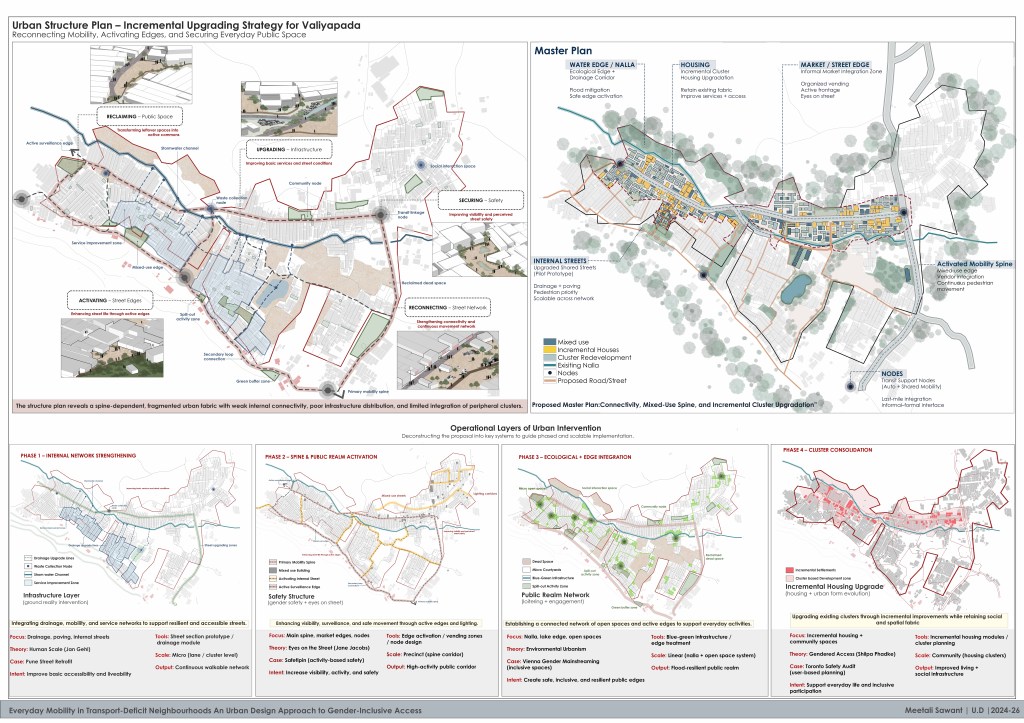
The study focuses on Valiyapada in Nallasopara East, within the Vasai–Virar
Municipal Corporation (VVMC), a rapidly urbanising transport-deficit
neighbourhood where everyday mobility is shaped by informal growth and
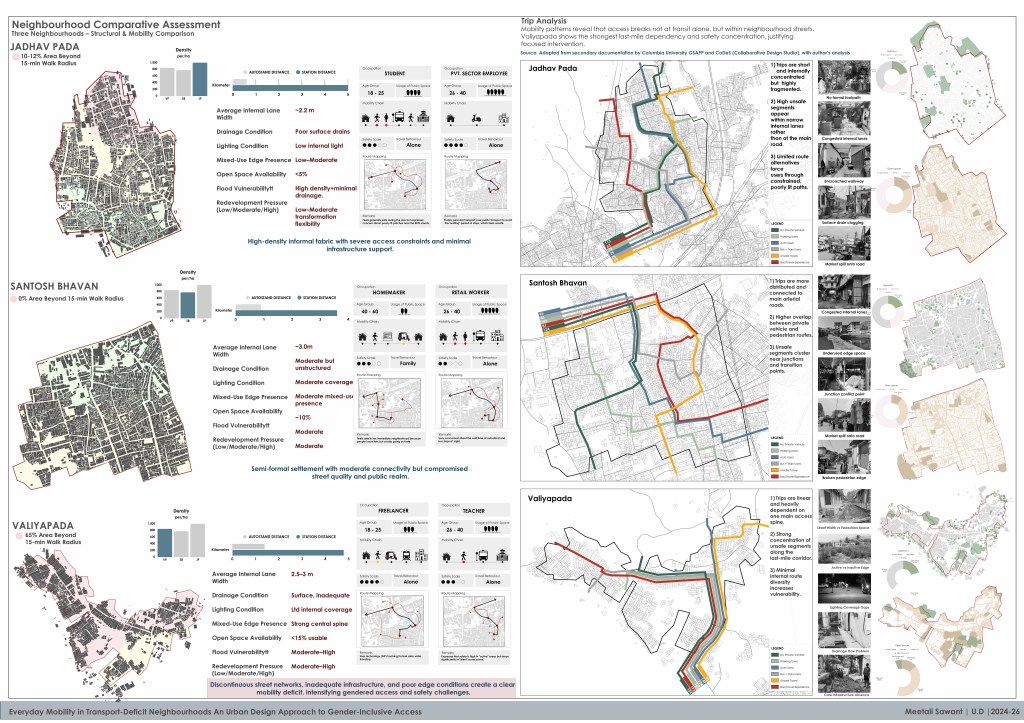
limited infrastructure. Through spatial mapping, mobility-chain analysis, field
observations, interviews, and comparative neighbourhood studies, the research
identifies how gaps in connectivity, inadequate infrastructure, flood-prone streets,
inactive public edges, and fragmented public spaces collectively influence
women’s daily experiences.
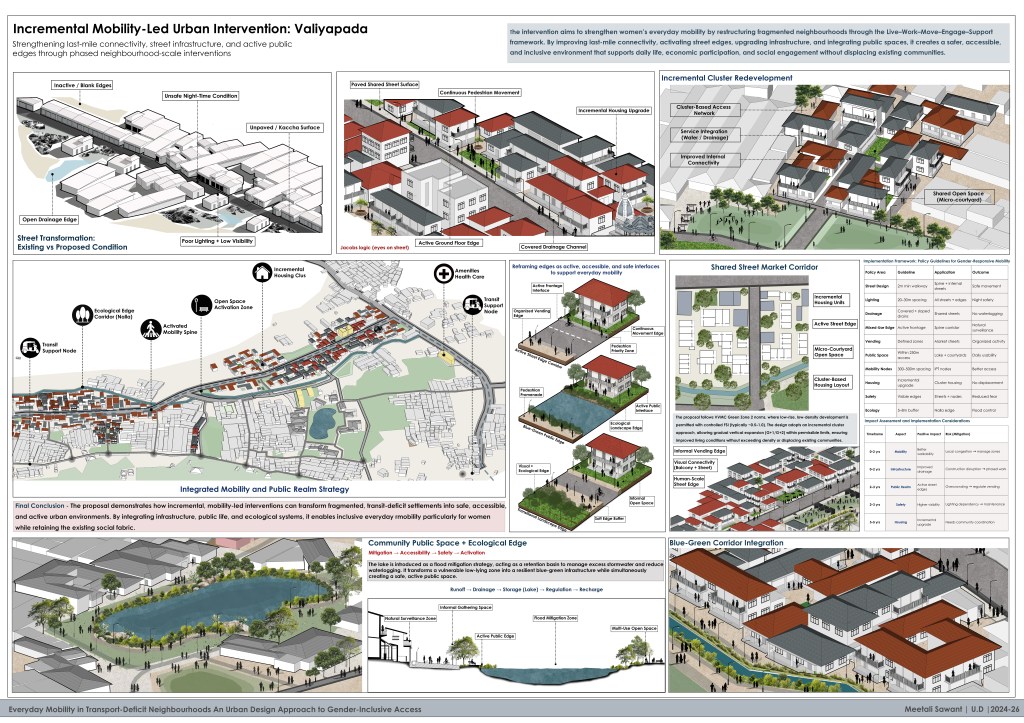
Rather than proposing large-scale redevelopment, the project adopts an
incremental, mobility-led urban design approach that strengthens existing
neighbourhoods through improved last-mile connectivity, pedestrian-friendly
streets, active public edges, ecological integration, and community-oriented
public spaces. By repairing the everyday mobility chain, the project demonstrates
that gender-inclusive cities are created not only through better transport systems,
but through streets, public spaces, and neighbourhoods that enable people to
move, pause, engage, and participate with safety, dignity, and confidence.
Image & Text Credit: Meetali Sawant | KRVIA Alumni | M. Arch – Urban Design Thesis | 2026


Leave a comment