
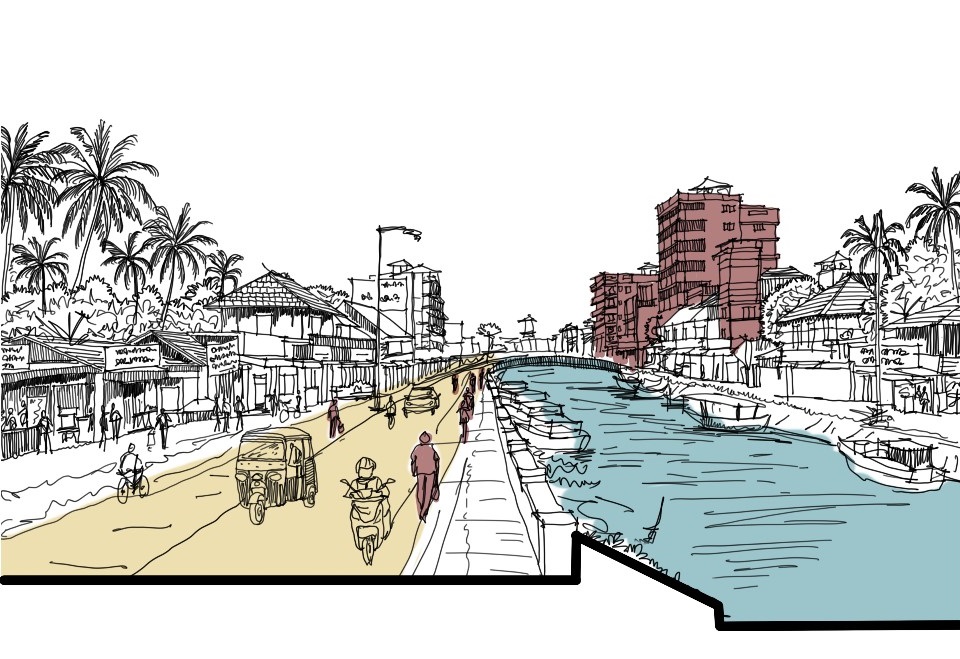
Memory, Ecology and Collective Space – A case of Alappuzha, Kerala
This thesis investigates the role of water systems as urban commons, positioning them not merely as ecological infrastructure but as living socio-spatial systems shaped by memory, livelihood, governance, and collective use. Focusing on the canal networks of Alappuzha, the study explores how these historically significant water bodies can be reimagined as inclusive, resilient, and culturally meaningful public environments.
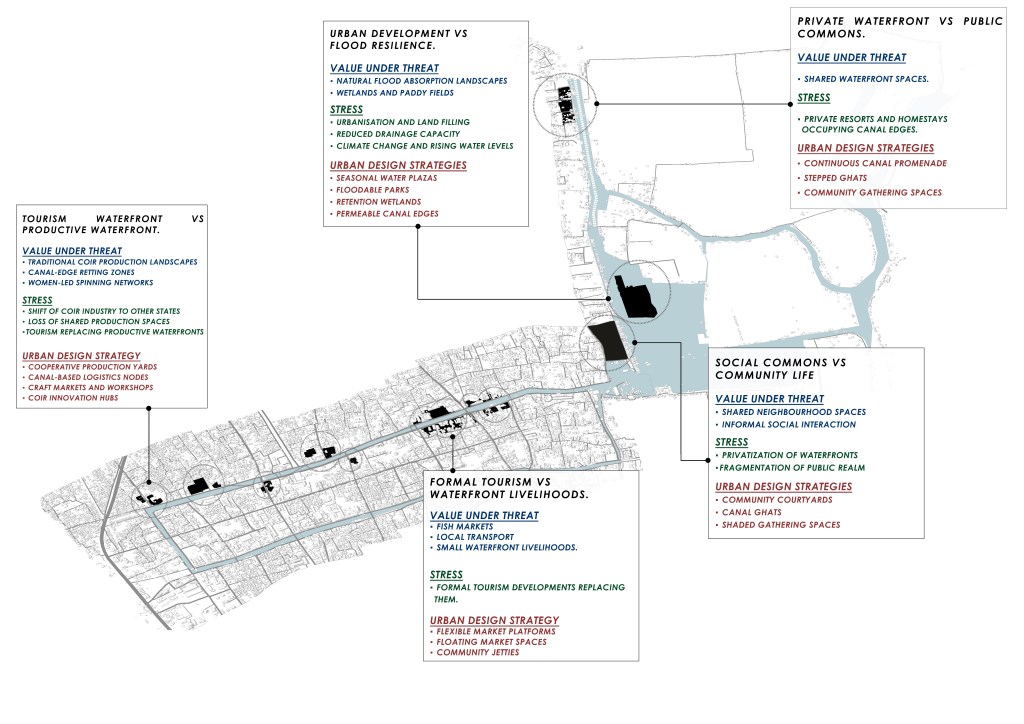
Urban commons have traditionally referred to shared natural resources collectively used and managed by communities. In contemporary cities, this idea extends to spaces and systems that sustain ecological balance, social interaction, and cultural continuity. Through the works of theorists such as Elinor Ostrom, Henri Lefebvre, and David Harvey, the thesis frames commons as negotiated spaces where governance, everyday practices, and rights to access intersect. It critiques fragmented approaches that isolate ecology, policy, or design, arguing instead for an integrated framework.
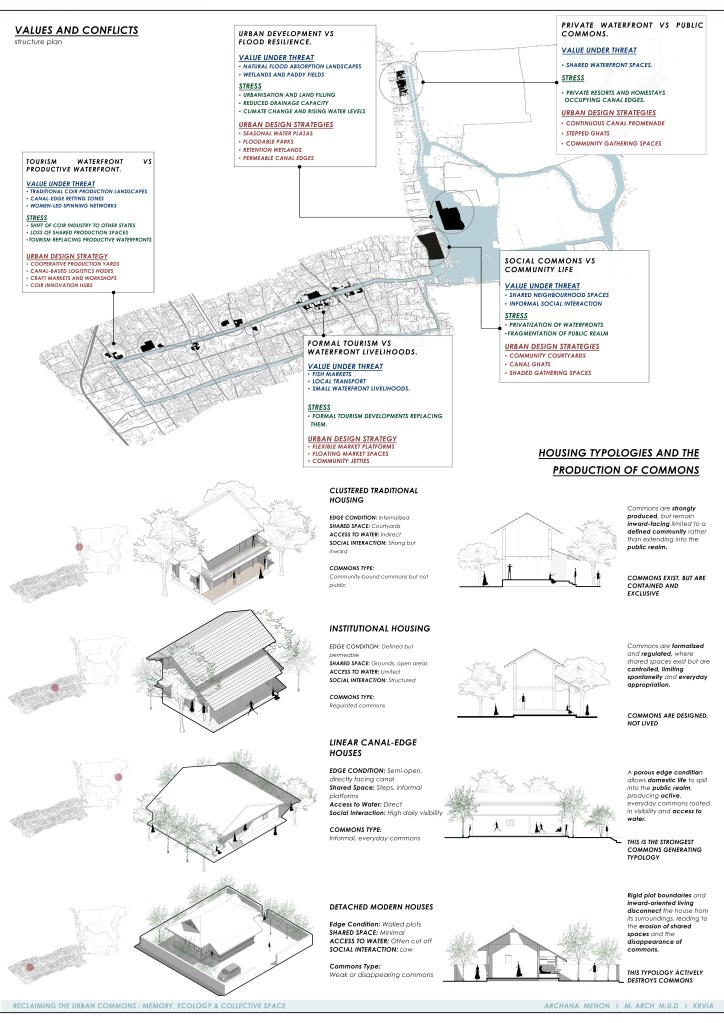
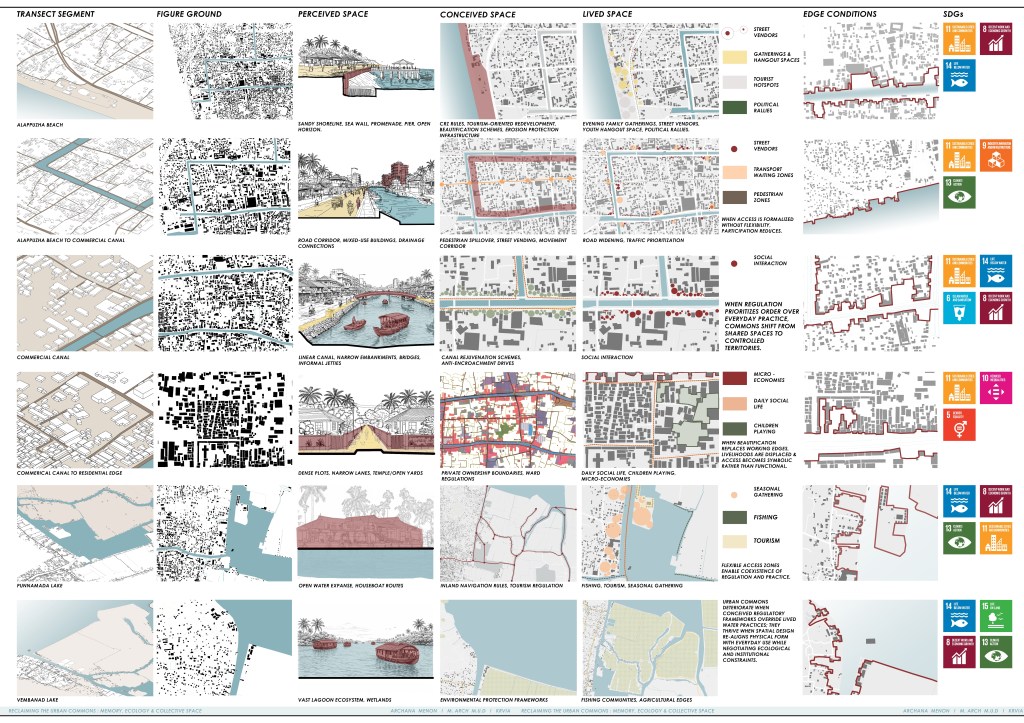
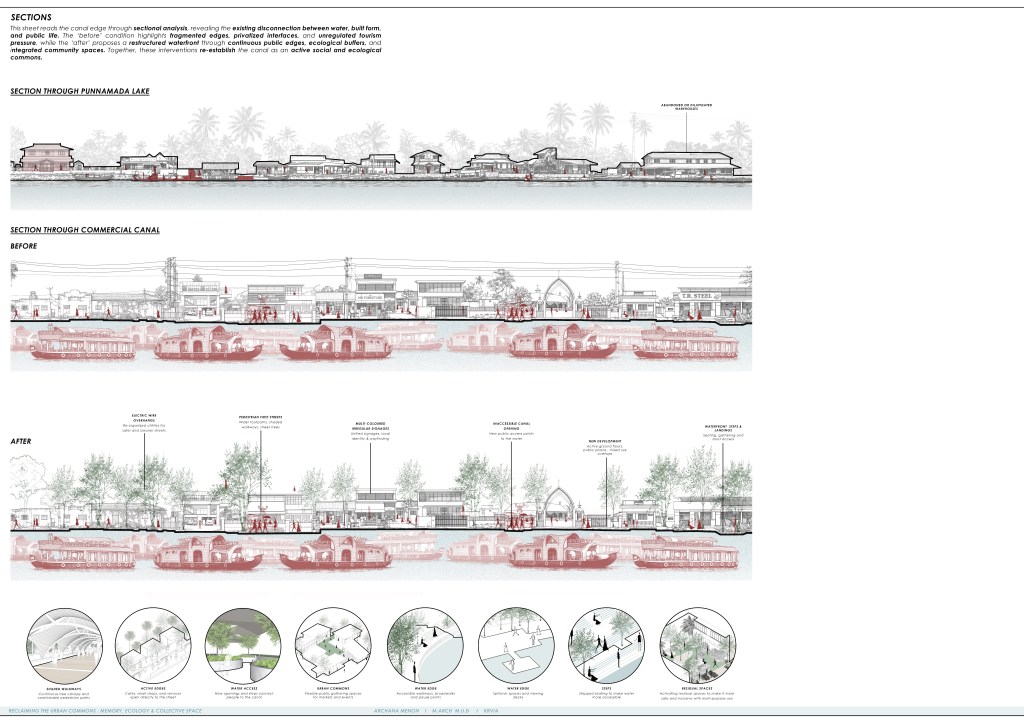
The site of Alappuzha provides a unique context due to its dense network of canals, lagoons, and backwaters that have historically supported transportation, fishing, coir production, rituals, and tourism. However, rapid urbanization, pollution, privatization, and tourism-led commercialization have transformed these systems into fragmented and contested landscapes. The research identifies a growing disconnect between local communities and the water edges, where once-shared spaces are increasingly enclosed or commodified.
The methodology combines site mapping, transect analysis, stakeholder interactions, and comparative case studies such as the Cheonggyecheon Stream, Sabarmati Riverfront, and Bishan-Ang Mo Kio Park. These instances reveal both opportunities and limitations in reclaiming water systems, particularly around questions of inclusivity, ecological resilience, and governance.

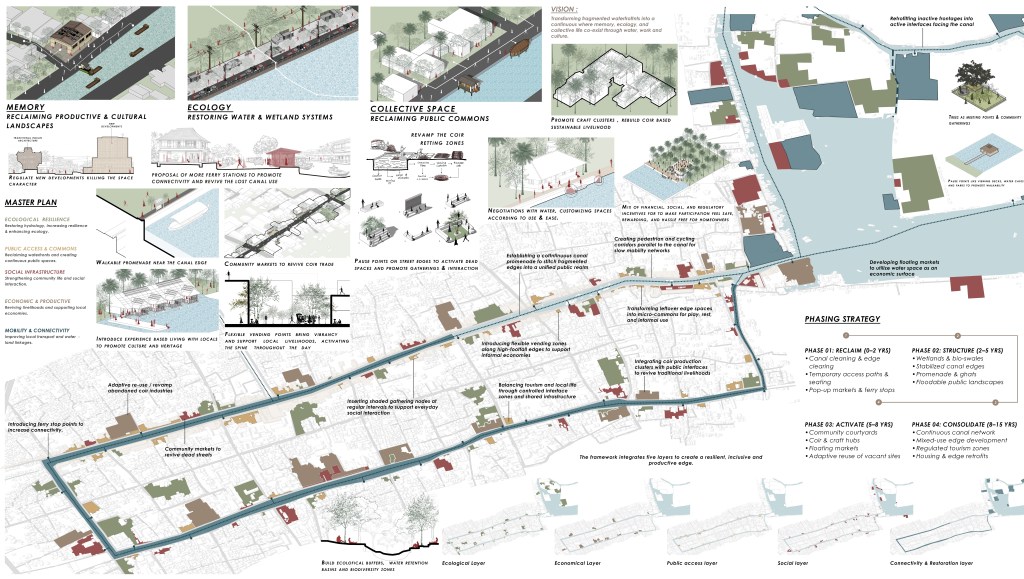
The thesis develops a design framework structured around three interconnected lenses: ecology, memory, and Collective Space. Ecology emphasizes restoring canals as living infrastructures through bio-filtration, permeable surfaces, and adaptive systems responsive to seasonal changes. Memory focuses on preserving and sustaining cultural practices such as fishing, coir processing, festivals, and informal gathering by designing spaces that allow continuity rather than monumental preservation. Governance addresses accessibility, stewardship, and
collective ownership, ensuring that the commons remain open and participatory.
A key contribution of the thesis is its understanding of space through Lefebvre’s triad of conceived, perceived, and lived space. This layered reading reveals how urban commons are continuously produced through the interaction of authority, physical form, and everyday life. Ultimately, the thesis argues that reclaiming water systems in Alappuzha is not simply an environmental act, but a socio-political and spatial project. By repositioning canals as urban commons, it proposes an alternative model for designing equitable, adaptive, and community-driven urban futures.
Image & Text Credit: Archana Menon | KRVIA Alumni | M. Arch – Urban Design Thesis | 2026


Leave a comment