
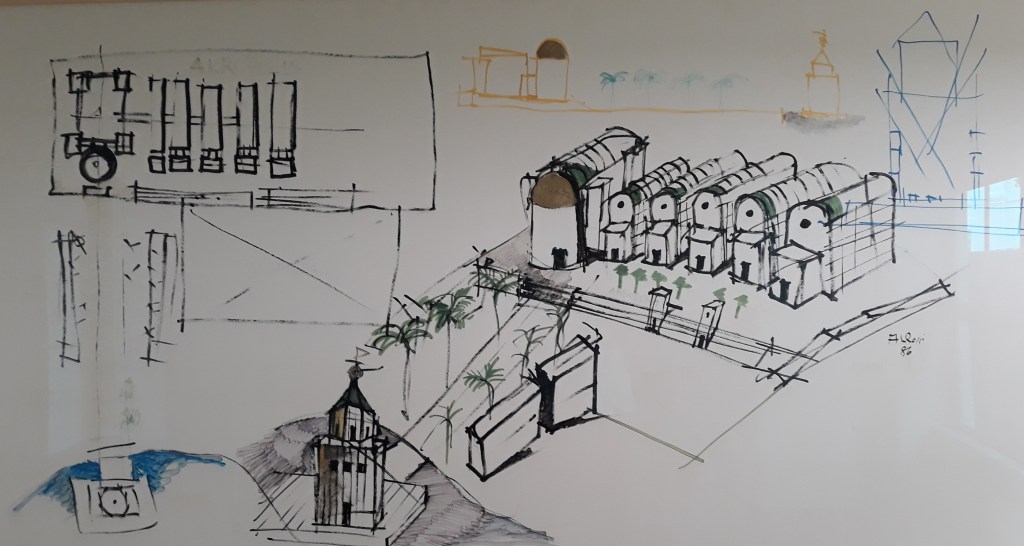
Architecture of the City: Aldo Rossi
Aldo Rossi’s seminal work, The Architecture of the City (1982), reshaped the discourse of urban and architectural theory by framing the city as a repository of collective memory and identity. Rossi’s emphasis on memory and history as structuring forces in urban form challenged the functionalist and technocratic paradigms of modernism, which tended to view the city as a system of efficiencies rather than meanings. Yet, while his notion of the city as a “collective artifact” introduced a profound cultural lens to architecture and urbanism, it also raised enduring tensions between historical continuity and the demands of contemporary urban change. In the theoretical framework of Aldo Rossi, the investigation of the city operates within a reflexive loop where reading and writing are inseparable acts mediated by memory. The researcher approaches the city with a scholastic disposition, interpreting it as a layered text whose meanings are never neutral but continually shaped by personal, collective, and disciplinary memories. These memories guide what is perceived, selected, and understood, ensuring that every act of reading is already conditioned by the past. Simultaneously, architecture functions as a form of writing, wherein new interventions are inscribed into the existing urban fabric, contributing further to its historical accumulation. Thus, the architecture of the city is situated in a dynamic in-between condition—neither purely analytical nor purely projective—where interpretation generates ideas, in turn, reconstitutes future readings. This ongoing oscillation sustains the city as an open, evolving construct, perpetually redefined through the interplay of memory, knowledge, and form.
Rossi’s central claim—that the city’s architecture reflects its social and historical narratives—positions memory as an architectural determinant rather than a mere affective layer (Rossi, 1982). In doing so, he reorients architecture from an act of aesthetic creation to one of cultural interpretation. However, this privileging of memory risks a form of historical determinism, in which the weight of the past constrains innovation and social transformation. As Lawrence (1985) observes, Rossi’s framework blurs the line between empirical urban analysis and metaphysical reflection, proposing memory as both analytical tool and emotional construct. While this dualism enriches architectural interpretation, it also makes Rossi’s methodology elusive, more poetic than practical for contemporary urban planning.
Jo (2003) extends this discussion by suggesting that Rossi’s designs evoke nostalgia and continuity, creating a dialogue between past and present. Yet this nostalgia can be read critically: rather than enabling urban dynamism, it may aestheticize decay or romanticize historical fragments detached from their lived socio-political realities. The city, under Rossi’s lens, becomes a monument to collective memory but risks overlooking marginalized or contested histories that challenge dominant cultural narratives. This selective memorialization suggests that Rossi’s “collective memory” is not entirely collective—it privileges formal and typological permanence over social heterogeneity.
Furthermore, while Rossi’s architectural philosophy expanded the conceptual boundaries of urban theory, it remains deeply Eurocentric and formally oriented. His focus on typology and permanence aligns more with the classical European city than with the fragmented, globalized metropolis of today. As Ghirardo (2019) points out, Rossi’s legacy lies in reasserting architecture’s cultural and symbolic resonance, yet his approach offers limited tools for engaging with rapidly evolving urban contexts shaped by globalization, migration, and technology. His insistence on stable urban forms appears increasingly at odds with emergent practices emphasizing adaptability, sustainability, and social equity.
Nevertheless, Rossi’s influence on memory-oriented architecture and urbanism cannot be understated. His insistence that the city be understood as a historical continuum challenges the tabula rasa logic of postwar reconstruction and contemporary redevelopment. However, the integration of memory in practice requires a critical interrogation of whose memories are being preserved and to what ends. Rossi’s theoretical resistance to contextual erasure remains potent, but its translation into equitable practice demands frameworks that engage more directly with power, identity, and urban diversity.
The Architecture of the City remains a cornerstone of architecture and urban theory—not for offering prescriptive, but for provoking critical reflection on the relationship between time, form, and meaning in architecture. Yet, as current scholarship indicates, Rossi’s celebration of collective memory must be re-examined through a critical lens attentive to inclusion, change, and pluralism. Far from a static artifact, the city today is a living, contested field of memories. Rossi’s work invites, but does not resolve, the challenge of designing for that complexity.
References
Lawrence, R. J. (1985). Architecture of the city reinterpreted: A critical review. Design Studies, 6(3), 141–149. sciencedirect.com
Jo, S. (2003). Aldo Rossi: Architecture and memory. Journal of Asian Architecture and Building Engineering, 2(1), 231–237. tandfonline.com
Ghirardo, D. (2019). Aldo Rossi and the Spirit of Architecture. Yale University Press. books.google.com
Image Credit: Manoj Parmar Architects


Leave a comment