
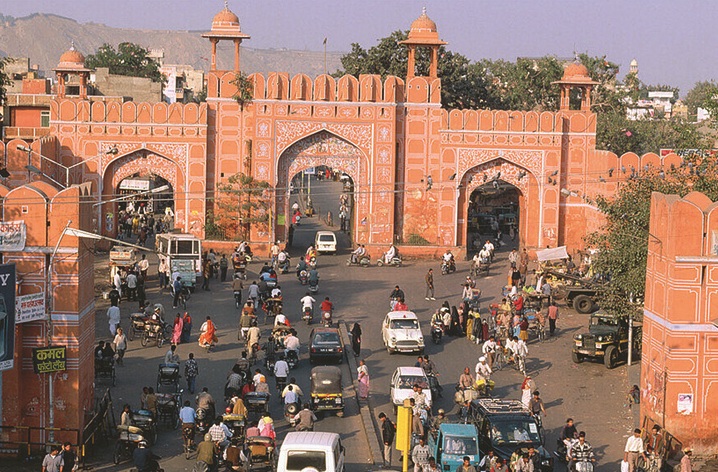
The physical environment of historic cities across Europe and Asia is rapidly transforming under development pressures, affecting local areas as well as entire urban cores. Despite these changes, historic cities remain living environments where social life, cultural practices, and intangible heritage coexist with contemporary lifestyles, extending beyond monuments and physical fabric. In recent decades, the relationship between culture, creativity, and urban development has gained prominence, with creative industries emerging as key drivers of sustainable urban evolution (UNESCO Creative Cities Network, 2004). Creative cultural clusters—urban areas where tangible and intangible heritage intersect with innovation—have become vital tools for economic, social, and spatial development, fostering resilience and inclusive growth.
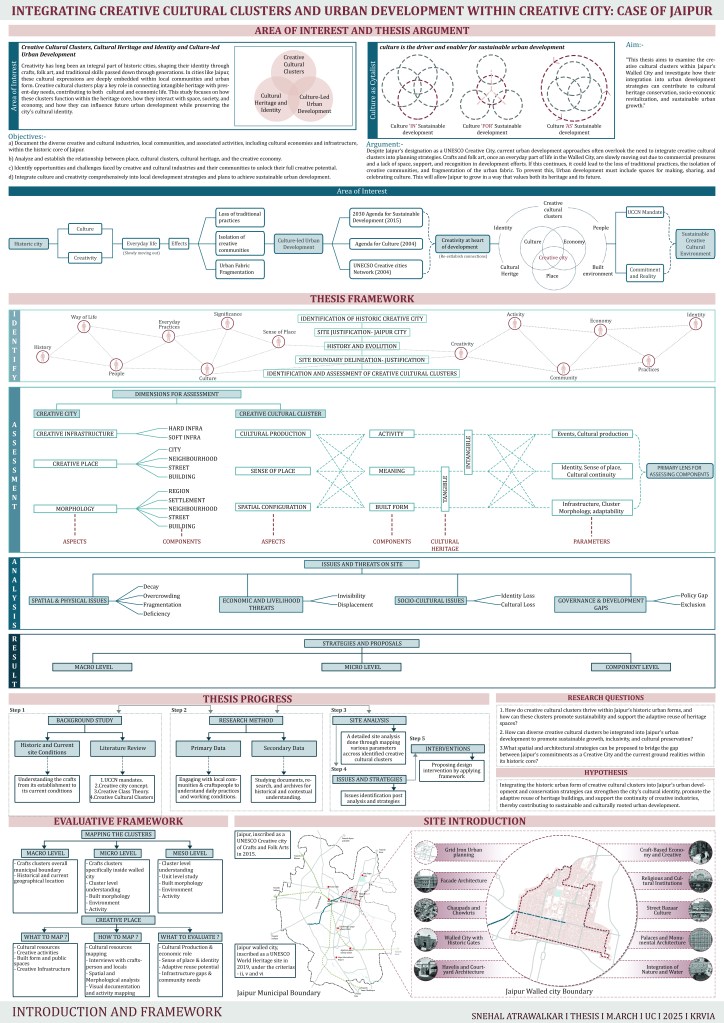
Within this context, the thesis Integrating Creative Cultural Clusters and Urban Development within a Creative City: Case of Jaipur examines Jaipur, a UNESCO World Heritage Site and Creative City of Crafts and Folk Art. Focusing on the walled city, the study explores how integrating creative cultural clusters into urban development can support heritage conservation, socio-economic revitalization, and sustainable urban growth while responding to contemporary challenges.
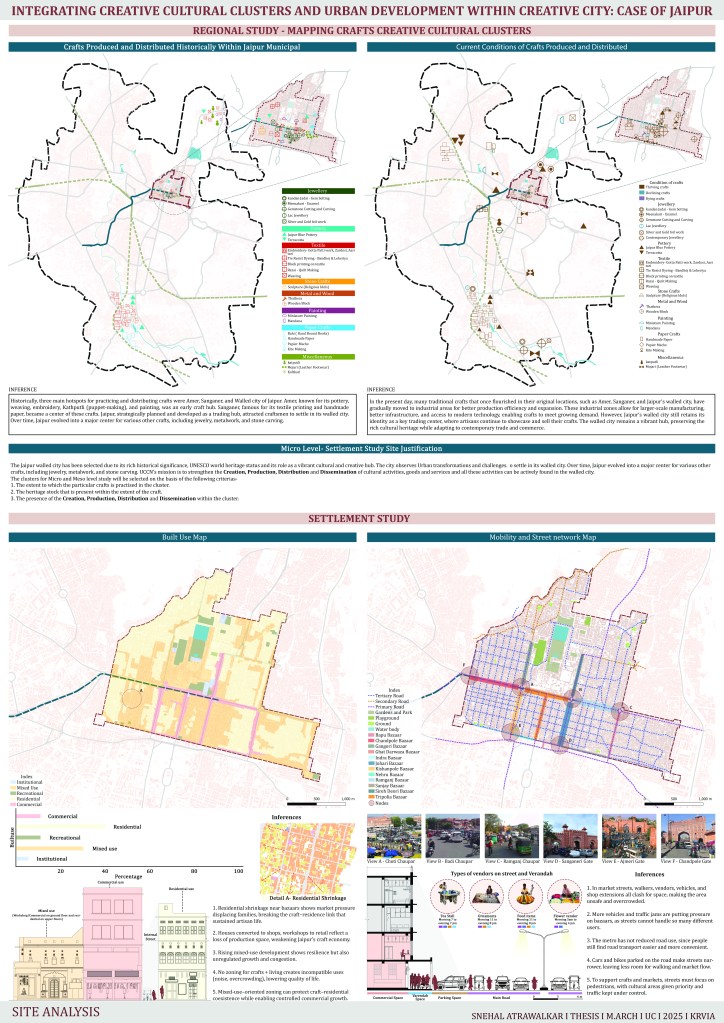
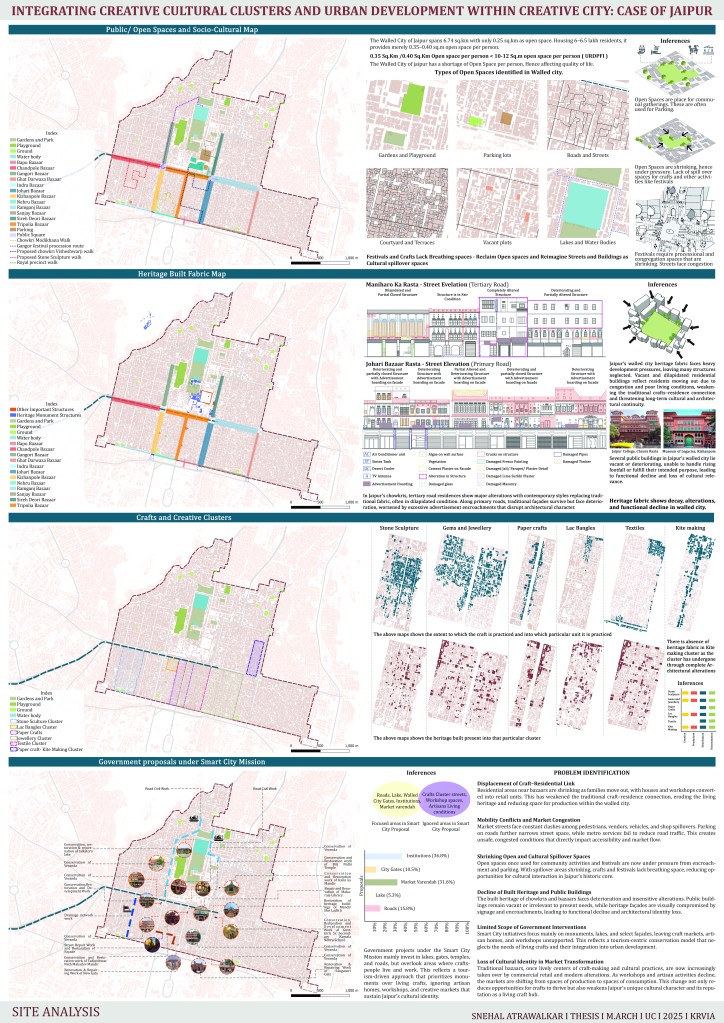
The research adopts a multi-scalar and mixed-method approach to examine the integration of creative cultural clusters within Jaipur, a UNESCO Creative City of Crafts and Folk Arts. The study begins at the regional scale by mapping craft clusters across Jaipur to understand their historical formation, spatial distribution, and role in shaping the city’s creative identity. Based on this analysis, the Walled City was identified as the primary focus area due to intense urban pressure, heritage concerns, and the decline of traditional crafts. At the settlement scale, urban development policies, planning frameworks, and ongoing projects within the Walled City were critically analyzed to identify gaps in cultural integration. The neighbourhood-level study involved detailed spatial, morphological, and socio-economic analysis of selected creative clusters, examining built form, activities, and craft-related challenges. An analytical framework structured around the dimensions of Creative City and Creative Cultural Cluster guided the assessment, enabling the evaluation of cultural production, sense of place, spatial configuration, and adaptability to inform context-sensitive urban development strategies.
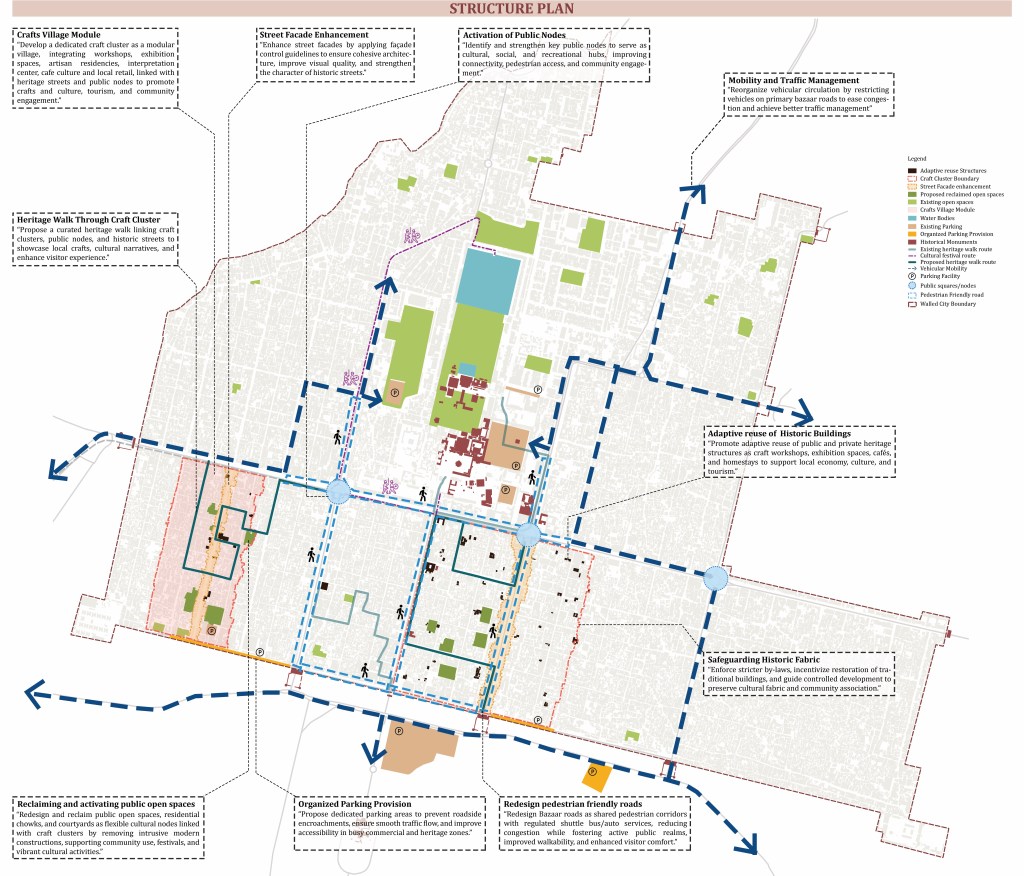
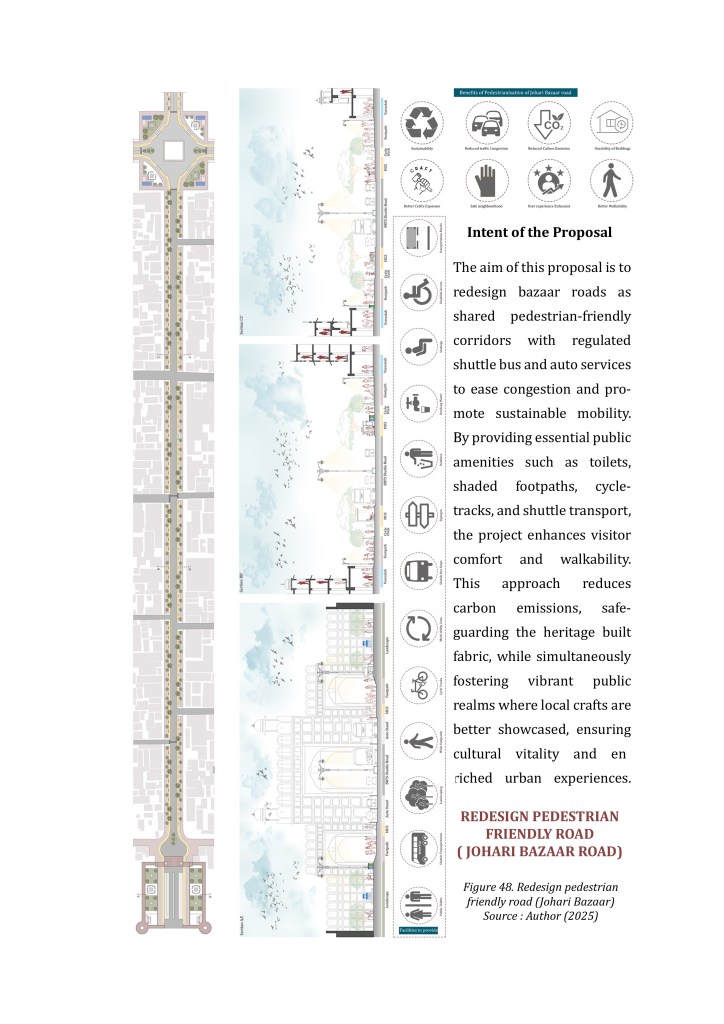
The Structure Plan outlines an integrated set of strategies to strengthen cultural identity, urban livability, and heritage conservation. It proposes a Crafts Village Module as a modular craft cluster integrating workshops, exhibitions, residencies, cafés, and local retail, supported by street façade enhancement guidelines to reinforce the visual character of historic streets. Key public nodes are activated as cultural and social hubs, while curated heritage walks connect craft clusters, public spaces, and historic streets. Mobility strategies include traffic restriction on primary bazaar roads, pedestrian-friendly shared streets, and organized parking provisions. Adaptive reuse of historic buildings and the reclamation of chowks and courtyards support cultural activities, local economies, and tourism, alongside safeguarding historic fabric through stricter by-laws and restoration incentives.
Image & Text Credit: Snehal Atrawalkar | Urban Conservation | 2025


Leave a comment