

An Approach towards Sustainable and Resilient Urban Development: Chennai
Urban food systems are critical to the social, economic, and environmental health of cities. Food is not merely a daily necessity but a vital thread connecting people, places, and systems—shaping neighborhoods through consumption patterns, cultural practices, economic activities, and ecological impacts. Yet, the dominant urban food systems today remain highly linear in nature, characterized by a one-way flow of resources from production to consumption and eventual disposal, often resulting in substantial environmental degradation, social inequities, and economic inefficiencies.

This thesis, titled “Integrating Urban Circularity into Foodscapes: An Approach towards Sustainable and Resilient Urban Development,” addresses the urgent need to transition from linear food systems to circular models that foster regenerative urban environments. Circularity in foodscapes refers to designing urban food systems where resources are cycled within localized networks, minimizing external dependencies and closing material loops through reuse, recovery, and regeneration. By embedding circular economy principles into urban foodscapes, cities can achieve enhanced resilience, social inclusivity, economic vitality, and environmental sustainability.

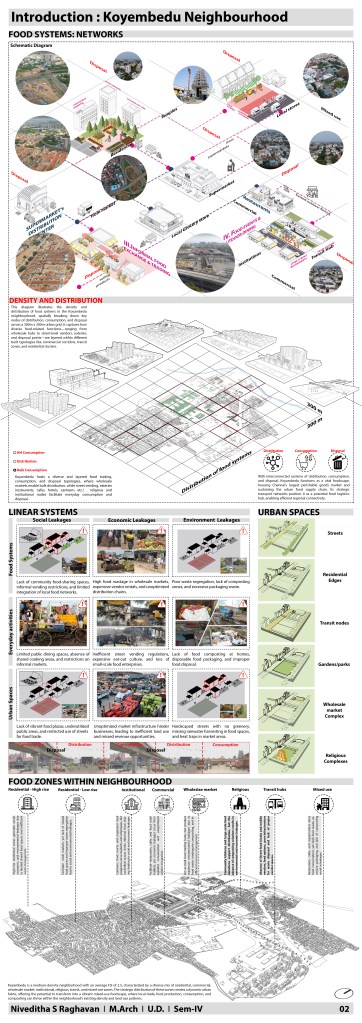
The research identifies neighborhoods as critical units of intervention, recognizing that food activities—distribution, consumption, and waste—are concentrated and most adaptable at this scale. The site study focuses on Koyambedu, a vital urban node in Chennai, known for hosting the city’s largest wholesale food market and acting as a major hub for food distribution. Koyambedu’s diverse land use patterns, dense transit networks, and existing informal economies make it an ideal microcosm to study food system inefficiencies and opportunities for circularity. Analytical layers mapped include food flows, resource leakages, built-use patterns, mobility systems, and public realm qualities.

Findings reveal significant leakages across all three dimensions: socially, there is a lack of inclusive community spaces and poor public realm integration; economically, informal and fragmented vendor networks weaken food system efficiency; environmentally, unsegregated waste, over-reliance on disposable materials, and absence of composting exacerbate urban vulnerabilities. The current foodscape operates largely linearly, with minimal feedback loops for resource recovery.The proposed toolkit introduces a modular framework of spatial and policy interventions designed to integrate food distribution, consumption, and disposal systems into Inclusive, Productive, and Regenerative Neighborhoods through context-specific circular strategies.
The proposed structure plan reimagines Koyambedu through circular urbanism, focusing on activating spaces at neighborhood scales. It is anchored on four key loops: Produce (urban farming, nutrient cycles), Trade (structured vendor networks), Consume (inclusive food plazas, community kitchens), and Compost (localized waste recovery hubs). Strategic spaces like institutional edges, streets, courtyards, and parking lots are repurposed as nodes for regenerative food activities. This integrated framework is guided by principles of restoring productivity, reclaiming public spaces, enabling flexibility, encouraging participation, and ensuring inclusivity.
Key interventions include the creation of Edible Green Corridors to integrate urban agriculture into street networks; Transforming Streets into Food Hubs to formalize and strengthen informal food economies; and the development of Composting Commons to facilitate decentralized organic waste recovery. These modular, scalable strategies are designed to close resource loops, enhance social inclusivity, and improve environmental resilience.
The thesis concludes by proposing a vision for Food Forward Neighborhoods—urban communities where food systems act as catalysts for social interaction, economic vitality, and ecological sustainability. By embedding circularity into everyday urban spaces and systems, the model aims to offer a replicable framework for other metropolitan areas seeking sustainable, resilient futures.
Image & Text Credit: Niveditha Raghavan | KRVIA Alumni | M. Arch – Urban Design Thesis | 2025


Leave a comment