

Case of National Park boundary in Thane City
Keywords: Transitional Zones, Sustainable Development, Ecological Sensitive zone, Form Based Codes, forest Indigenous Communities
In the context of rapid urbanization and growing environmental pressures, transitional zones between forests and cities offer important opportunities for sustainable development. These areas, where natural ecosystems and built environments meet, are critical not only for enhancing biodiversity but also for supporting the traditional livelihoods of Indigenous communities. This study focuses on developing strategies that harmonize growth with ecological sensitivity by integrating sustainable design practices and addressing both spatial and livelihood challenges faced in these regions.
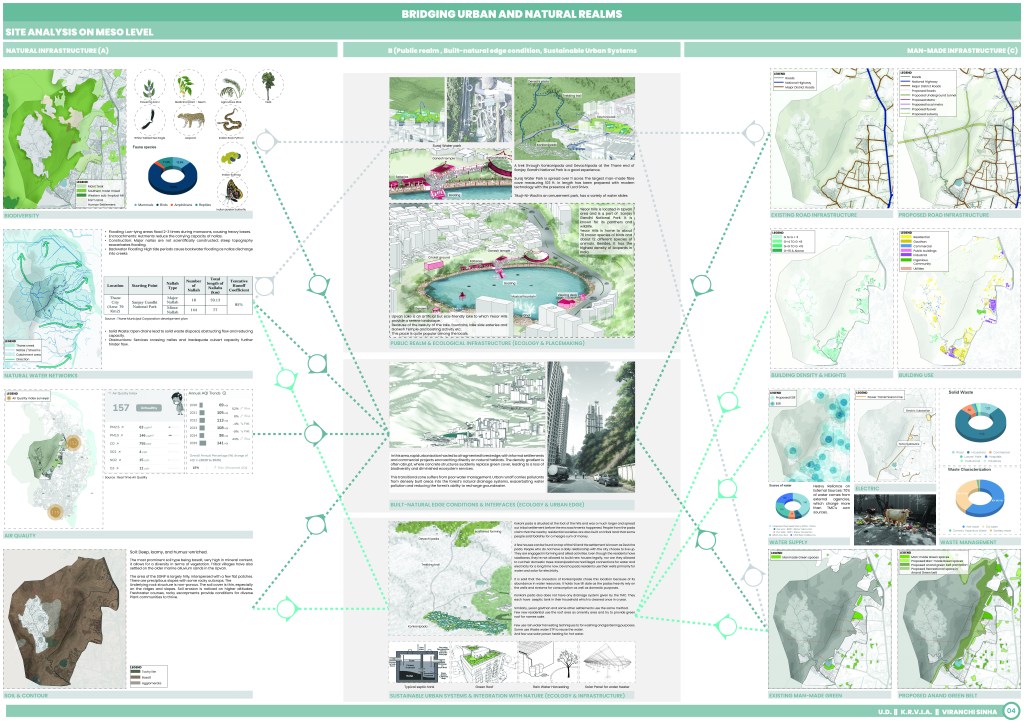
Working in these transitional zones presents unique complexities. Developers must navigate layered regulatory frameworks, balance ecological preservation with urban demands, and manage conflicting interests among diverse stakeholder groups. While ecological design, form-based codes, and community participation have been widely discussed in existing literature, few studies have comprehensively addressed the on-ground realities of such edge conditions. This research bridges that gap by engaging key stakeholders—including local residents, planners, developers, and environmental experts—to understand the interplay between natural systems and human-made infrastructure.
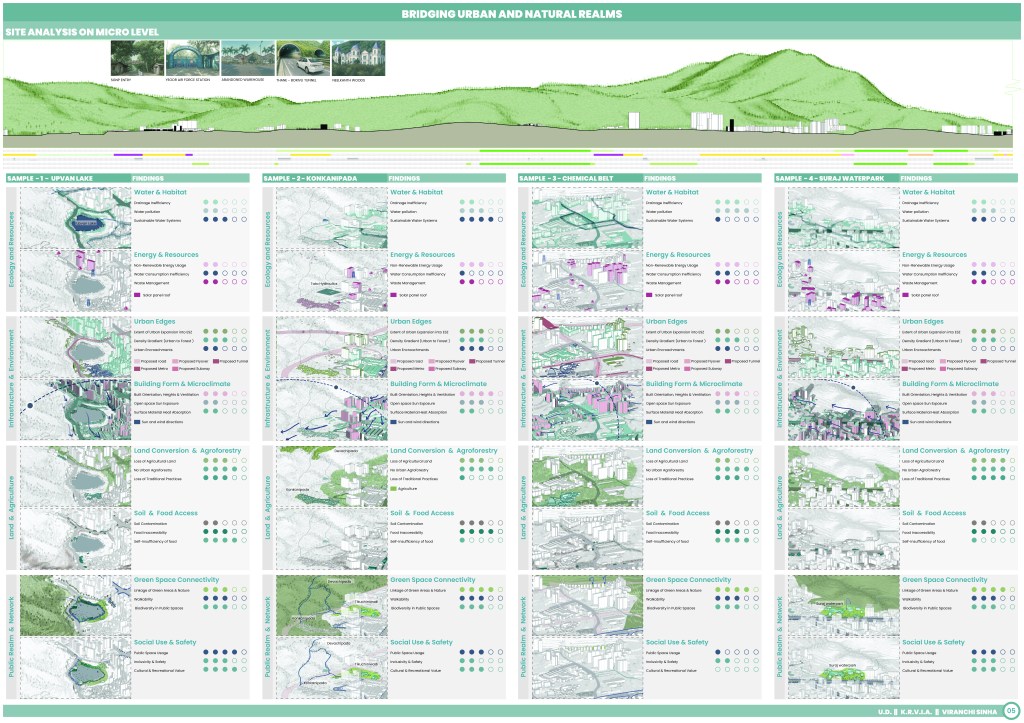
Adopting a macro-to-micro approach, the study combines qualitative interviews, quantitative surveys, and advanced GIS mapping to analyze environmental and infrastructural patterns. Spatial visualizations and stakeholder discussions were crucial in identifying ecological corridors, zones of urban encroachment, and potential intervention points.


The focus area for this research spans from Yeoor Hills and Upvan Lake to Suraj Waterpark, along the Sanjay Gandhi National Park boundary in Thane City. This location embodies the tensions typical of transitional zones, where ecological sensitivity meets intense urban pressure.
The resulting strategic framework proposes integrating sustainable design principles at the policy level, specifically through form-based codes that regulate building heights and land use near forest edges. This helps maintain connectivity between green spaces and prevents ecological fragmentation. The framework also emphasizes decentralized water management strategies, such as rainwater harvesting and on-site wastewater treatment, along with renewable energy adoption through solar panels. These measures aim to mitigate challenges related to water scarcity, heat buildup, and inefficient waste management.
In short, the study provides a cohesive blueprint for balancing economic development with ecological conservation. By prioritizing natural systems in urban design and planning processes, it offers a practical model for managing transitional zones sustainably and responsibly.
Text & Image Credit: Viranchi Sinha | KRVIA Alumni | M. Arch – Urban Design Thesis | 2025


Leave a comment