

Case Study: Panaji | Goa
Keywords: urban resilience, coastal cities, systems approach, resilience assessment, networks
Around the world, coastal cities exhibit a great degree of heterogeneity in their environments, urban form, connectivity and socio-economic activities, owing to their unique geographical features. These areas are particularly vulnerable to climate change and environmental challenges such as sea-level rise, flooding, extreme weather conditions, and coastal erosion and have a significant impact on the urban form and mobility patterns in coastal cities. Moreover, rapid urbanization, intensification of and changes in land use place growing pressure on the sensitive coastal environment.
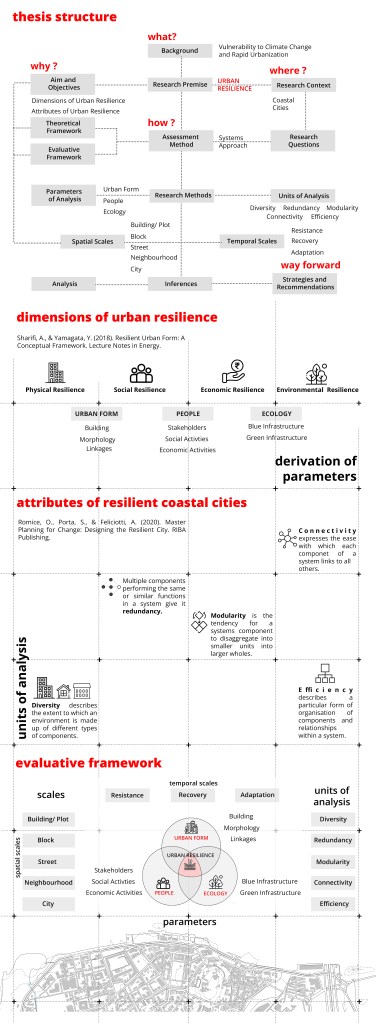
However, there is limited understanding of the interaction between urban and coastal systems, yet it is significant because these factors inform the urban form of the cities and have a direct impact on how people move through these coastal zones and the resilience of these systems to disruptions. While the urban form of cities may be considered non-deformable and rigid, its properties influence urban socio-economic and environmental dynamics. Despite a large body of literature published on urban resilience, research on resilience of urban form is still scarce. This thesis seeks to take a step towards filling this gap by discussing the concept of resilience thinking, identifying critical parameters and units of analysis leading to vulnerabilities and inadequacies in resilience planning and implementation by developing a conceptual framework for analyzing urban resilience in coastal cities.


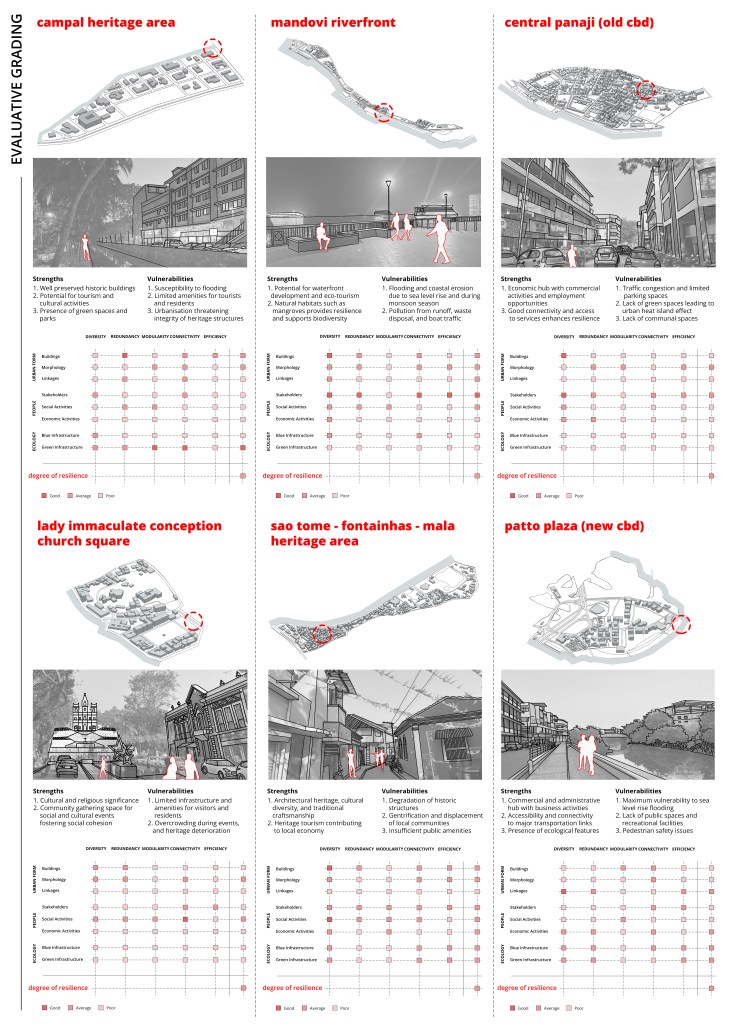

The study employs a systems approach to uncover the inter-dimensional relations between urban form, people, and the ecology. Despite the evaluative framework being generic, the findings and recommendations in this thesis intend to be context- specific and hence the coastal city of Panaji has been taken as a case study. By analyzing site-specific vulnerabilities and stakeholder perspectives, the research intends to identify contextually appropriate strategies for the adaptation of urban forms, promotion of socio-economic diversity, and the integration of ecosystem-based strategies at spatial scales of building/ plot, block, street, neighborhoods, and city level as well as temporal scales of resistance, recovery, and adaptation to enhance the overall resilience and sustainability of coastal cities. Keywords: urban resilience, coastal cities, systems approach, resilience assessment, strengthening networks.
Text & Image Credit: S. Prashitha | KRVIA Alumni |M. Arch – Urban Design Thesis


Leave a comment